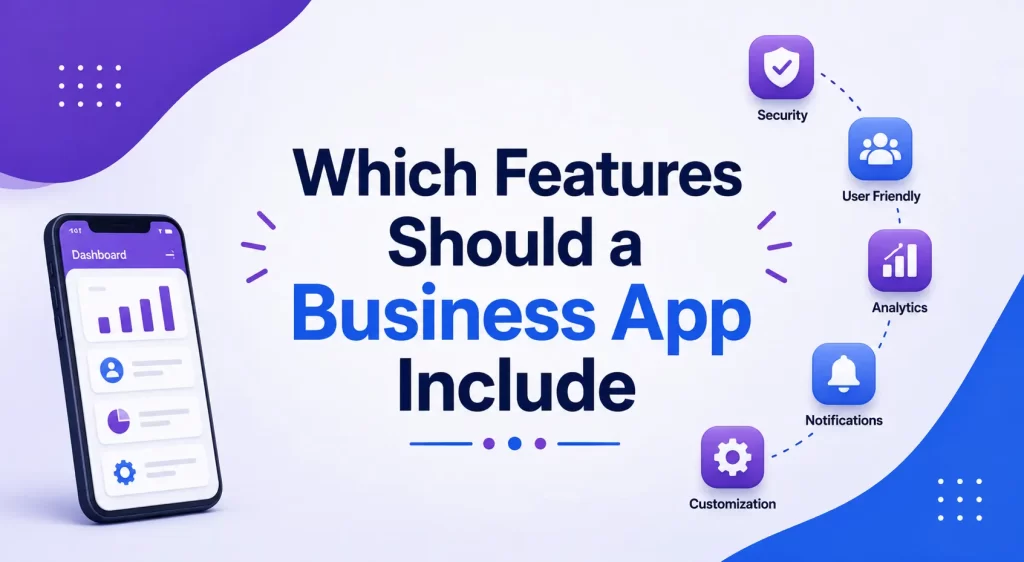
Mobile applications have become a necessity for businesses in the digital age to enhance customer interaction, simplify internal processes, and raise awareness of the brand. A well-designed business app can assist enterprises to communicate with their customers effectively and, at the same time, provide easy-to-access services and superior user experiences. Even so, a business app should possess the appropriate features that satisfy customer requirements and business objectives to be successful.

Use-Friendly Interface
One of the most important features of a business app is a simple and user-friendly interface. Navigational simplicity and visual attractiveness are the two factors that mainly drive user preference for apps. Explained menus, fast loading, and a seamless way of navigation will definitely improve the user experience and have the app being used regularly by the customers.
Secure Login and Authentication
Security has always been and will always be the number one priority for any business app. Besides the usual password protection, there should be also login options that support 2FA (two-factor authentication) and biometrics. Such features are good not only for securing the customer information but also for preventing unauthorised access.
Push Notifications
Push notifications can effectively alert customers to discounts, updates, alerts, and other announcements. Companies can leverage notifications to increase customer interaction, advertise new products, and encourage app use. However, notifications must be pertinent and sparing.
Fast Performance
It is the standard that apps respond instantly and without glitches. Apps that take time to load are a big part of negative user experience, and such apps are usually uninstalled. A company app should be made with speed, performance, and device/OS compatibility in mind.
Customer Support Integration
Offering customer service via a mobile app is one of the easiest ways to enhance customer satisfaction. Implementing features like live chat, a help centre, an FAQ, or support tickets enables users to obtain aid without any difficulty at any time.
Easy Payment Options
If a business is selling goods or services, having secure, safe and user-friendly payment methods is necessary. Customers’ comfort can be increased by offering them several ways to make payments, such as credit cards, UPI wallets, and online banking, while at the same time raising the likelihood of successful transactions.
Data Analytics and Reporting
One of the features that business applications should come with is an analytics component that tracks the behaviour of users, identifies customer preferences, and measures the performance of the app. This data helps businesses to make better decisions and to come up with smarter advertising strategies.
Cloud Integration
With cloud integration, users can obtain their data at any location without compromising on the security of storage and backup. Besides, cloud services allow organizations to handle files, customer data, and internal processes effectively.
Social Media Integration
It is no secret that integrating social media platforms into an app can a lot increase brand exposure and customer engagement. Besides, it allows users to share content, reviews, or products directly through social media channels, making it quite effective.
Regular Updates and Security Features
An app for business that works will always require the least time for an update or a new release to make it better for performance and security. Security features like data encryption or secure APIs assist in safeguarding sensitive information against cyber-attacks.
Conclusion
Besides offering simple functionalities, a business app’s features should also include elements known as user-friendly design, strong security, fast performance, payment integration, customer support, and analytics, which a lot contribute to the app’s success. Businesses that pay for the right mobile app features get the benefit of better customer engagement, increased efficiency, and a stronger digital presence in a highly competitive market.