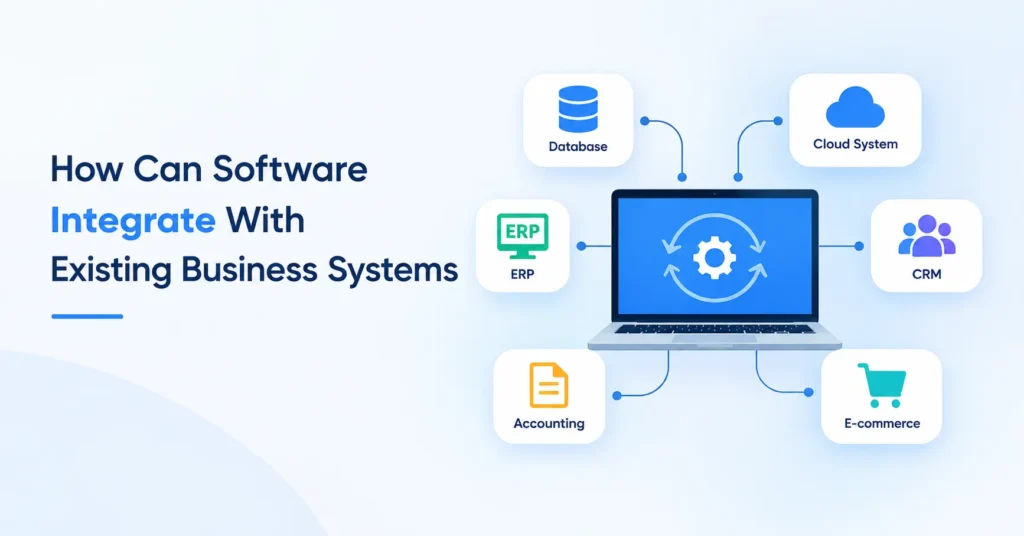
In today’s digital business environment, organizations rely on various software solutions to manage their day-to-day operations, customer relations accounting sales, inventory, and what their employees are doing. But when those software solutions are isolated from each other, companies can encounter duplicate data, communication problems and delays. Software integration brings these software applications together to share information.
By using software integration services you can keep your existing tools and add new applications, increasing efficiency and productivity, saving time, and enabling you to make better business decisions.
What Is Software Integration?
Software integration is used to make sure two or more applications, platforms, or systems connect with each other and work together to exchange data and other functions. With this integration, businesses will no longer have to keep data manually in separate applications; instead, they will be connected.
Take the example of when a company has a set of CRM software integrated with the accounting software. Then when the sales person creates new customer order, details of the same can be automatically exported to the accounting system.
Custom software development services enable businesses to create integrations tailored to their unique workflows, technical needs, and long-term objectives.
Why Do Businesses Need Software Integration?
Most companies use many digital tools to support the running of their business. When disconnected, people may have to duplicate enter data into multiple tools.
Here are some of the major reasons businesses invest in business software integration.
1. Improve Operational Efficiency
Automating business, applications, automates, repetitive, tasks, and decreases the need for human intervention. This means employees can spend less time in data entry and more time doing business.
For example, software that manages inventory can be linked with an online selling service, so that when a customer places an order, the amount of stock available is automatically updated.
2. Reduce Data Errors and Duplication
Manual entry of information into several, applications, often, means, errors, and inconsistencies. Integrating software systems enables data to transfer between connected applications based on established rules.
This helps to ensure the same information is being maintained for all departments and helps to improve the accuracy of business data.
3. Improve Data Accessibility
Easy access for authorised users when information shared across all integrated functions – departments like sales finance operation or customer support teams work from the same page information is easier for authorised employees to access.
4. Support Business Growth
Growing businesses need to keep up with larger operational needs. Scalable software integration solutions enable them to add more apps, automate more processes, and process more data all without having to build an entirely new technology system.
What Are the Common Methods of Software Integration?
There are many ways to connect existing applications, choosing the right approach depends on the business’s software budget security requirements, and IT skills.
API Integration
APIs(Application Programming Interfaces) APIs provide a series of rules to allow different software applications to communicate.
For instance, a company can connect its website to an API for billing, CRM, or a shipping application. Typical uses of APIs include structured communication between similar systems.
Middleware Integration
Middleware is like a translator between your apps. It enables these systems to communicate with each other even if they were built with different technologies or data structures.
Read more this is ideal for organizations that have multiple applications and a single integration layer on top for communication.
Database Integration
Database integration links data sources, allowing information to be shared or synchronized across systems. When selecting this approach, businesses need to manage permissions, maintain data consistency, and ensure security.
Cloud-Based Integration
Cloud integration links cloud applications with other cloud platforms or on-premises systems. This approach can assist businesses in synchronizing data across accounting software, CRM systems, e-commerce platforms, and enterprise solutions.
The easiest way will depend on what technology systems already exist and the extent of systems integration needed.
How Can Software Integrate With Existing Business Systems?
Having a disciplined way enables businesses to lower project issues during implementation, leading to improved outcomes of their software integration initiatives.
Step 1: Evaluate Existing Systems
First review the current applications being used within the organization. Determine how they work, and what is lacking, the type of data and how it integrates with the other applications in use.
By conducting this evaluation, organizations can identify where integration is necessary and how automation can add the most value.
Step 2: Define Integration Requirements
Define the goals before beginning development. For instance, the company may be looking to merge customer records, enable automatic invoices, or integrate inventory data with an online storefront.
Explicit specifications enable the developers to choose the most appropriate integration technique, and to eliminate the superfluous.
Step 3: Choose the Right Integration Approach
Choose an approach that considers ease of integration scalability security, and cost. You may be guided to use API Middleware Cloud Connectors, or develop a custom integration, according to the project.
A professional software development firm can assist firms in weighing their options.
Step 4: Develop and Configure the Integration
Developers set up the way the applications communicate, determine how data is represented in each field, establish authentication, and control how information moves between systems.
You might require custom software development if existing software solutions do not have the needed connectors or if you require custom, business-specific logic.
Step 5: Test the Integrated Systems
Still, testing is very important before launching an integration. Developers need to test: data correctness system stability error handling security measures Integration with other tools.
Using the test with real-world scenarios helps discover problems before they impact daily operations.
Step 6: Monitor and Maintain the Integration
Once installed, it is recommended that organisations monitor the solution once live, and fix issues as they occur. Updates to the software, changes to the APIs and evolving business needs might cause adjustments to the integration.
Ongoing maintenance helps keep connected systems reliable and secure.
How Can Custom Software Development Services Help?
Custom software development services enable companies to connect the applications that suit their type of business operations. Developers can write custom APIs, automate processes, build middleware, and integrate legacy applications to new systems.
These services may also be used for third-party software integration, enterprise application integration, or business process automation.
When people talk about integrating systems, they often focus on getting systems talking to each other. But the right integration strategy will help organizations to deliver productivity, ensure data consistency, and to get maximum value out of technology investments.
Frequently Asked Questions
1. What is software integration?
What is software integration? Software integration is the process of joining multiple applications together so they can transmit data to each other, automate processes, and work seamlessly.
2. Why is software integration important for businesses?
software integration Simplify processes and eliminate manual data entry. Prevent errors and provide your employees with the tools to manage data more easily.
3. How can software integrate with existing business systems?
Software can be connected to existing services by using APIs middleware database connections, and integration software.
4. What are the benefits of business software integration?
The key advantages are increased productivity, sharing the correct data, automation of the workflow, and reducing operational costs, and better decision making.
5. Can custom software development services integrate legacy systems?
Yes. Custom software development services can integrate legacy applications with new ones via appropriate APIs and middleware or by designing a custom integration solution.
Conclusion
Software integration helps businesses connect their existing applications, automate repetitive tasks, improve data accuracy, and increase operational efficiency. Whether your organization needs CRM integration, accounting software integration, or e-commerce platform integration, the best approach depends on your current systems and business goals.
Through proper planning, testing, and continued upkeep, organizations can add new innovations without having to replace their current infrastructure unnecessarily. By investing in the right software integration solutions, organizations can create a more interconnected, scalable, and productive company.